Miami-Dade Sewer Overflow Data Tracker & Causes
Miami-Dade sewer overflow data is useful, but it is easy to read too much into a single map pin or gallon estimate. A public report can tell you that a sanitary sewer overflow was logged, where it was reported, whether wastewater was believed to have reached surface water, and how much was estimated or recovered. It usually cannot tell you whether your specific floor drain is next, whether a private lateral is failing, or whether one spill caused a specific fish kill, algae bloom, or illness.
That distinction matters for homeowners, condo boards, landlords, restaurants, and property managers. A municipal force-main break and a grease blockage inside a building can both put sewage where it does not belong, but the response, responsibility, insurance question, and prevention plan are different. This guide explains how to use Florida DEP wastewater incident reporting, Miami-Dade Consent Decree reports, and field clues without turning public data into unsupported certainty.
The short version: treat official overflow data as a risk signal, not a property diagnosis. Use it to understand the public system, recurring causes, and receiving-water caveats. Use a licensed plumber, camera inspection, and building-specific records to understand what is happening at your address.
Public Sewer Overflow vs. Private Building Backup
When sewage enters a home or spills onto a street, the first useful question is not "how many gallons?" It is "which pipe failed?"
EPA describes a sanitary sewer overflow as a release of untreated or partially treated sewage from a municipal sanitary sewer system. In Miami-Dade's Consent Decree language, a public SSO can include wastewater released from the county wastewater collection and transmission system to water or to public or private property. That can include a manhole overflow, force-main break, pump-station problem, or a building backup caused by a failure in the publicly owned system.
A private backup is different. It usually starts in the building drain or private sewer lateral: the pipe that carries wastewater from the house, duplex, restaurant, apartment building, or commercial space toward the public main. Miami-Dade's utility information page tells customers that connections from the sewer main to the facilities within the customer's property are the customer's responsibility. The Consent Decree also separates a "Private Lateral" problem from a county "Building Backup."
That sounds technical, but the practical difference is simple:
| Situation | What it usually points to | Why it matters |
|---|---|---|
| One toilet, tub, or floor drain backs up while nearby fixtures still drain | Fixture branch, trap, or short building-drain blockage | A plumber can often clear or diagnose the local line before the public utility is involved. |
| Multiple low fixtures back up at once, especially on the first floor | Building main drain, private lateral, or public main surcharge | Stop water use and get a licensed diagnosis quickly; the lowest drain becomes the relief point. |
| Sewage is coming from a manhole, street, easement, or pump-station area | Possible public SSO | Report it to the utility or the State Watch Office; avoid contact with standing wastewater. |
| Several neighboring buildings report backups during the same event | Public main restriction, pump issue, or area-wide surcharge is more likely | Documentation matters because responsibility and claims can change. |
The most expensive mistake is assuming responsibility before the pipe is located. A video camera inspection can show whether roots, broken cast iron, a belly, grease, scale, or a collapse is inside the private lateral. It can also help document the distance from the cleanout to the defect, which is often the detail that decides whether the next call is to the property owner, the association, a site contractor, or the utility.
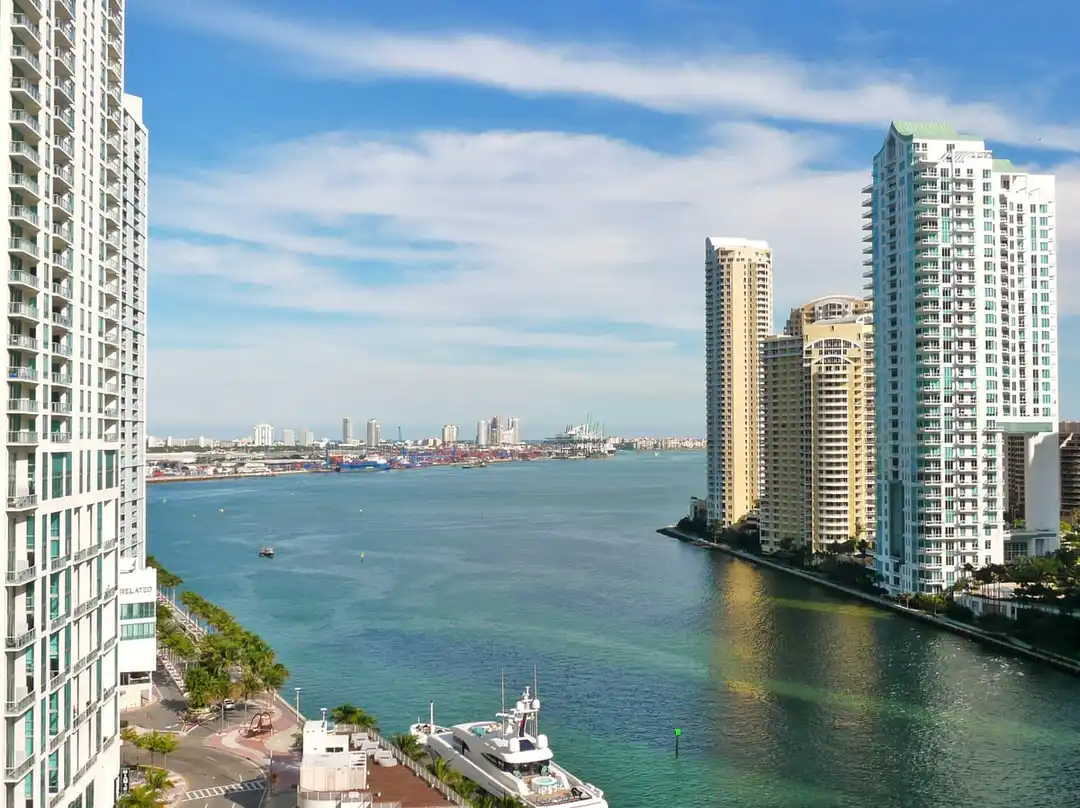
 Biscayne Bay is one of the receiving-water names readers may see in public pollution notices, but a report field is not the same as a site-specific water-quality study.
What Reported Gallons Can and Cannot Tell You
Reported gallons are the headline number most people remember. They are also one of the easiest numbers to misuse.
Florida DEP's wastewater incident guidance says reports can include the estimated amount of discharge in gallons, the source and cause, whether the discharge was contained, cleanup actions, and the name of any affected water body. The state's sanitary sewer spill layer also has fields for whether the released quantity is known, the estimated quantity released, the quantity recovered, whether the release reached waters, whether it migrated off site, and the affected water body.
Those fields are helpful, but they are not laboratory instruments. A reported volume may be based on pump run time, pipe diameter, flow estimates, visual observation, recovery truck totals, or follow-up calculations. Two incidents with the same gallon estimate can have very different outcomes if one is quickly contained on pavement and recovered while the other enters a storm drain during heavy rain.
Use gallon numbers this way:
- Good use: Compare the rough scale of incidents, identify which reports deserve closer reading, and see whether a large release had a recovery volume or receiving-water note.
- Risky use: Treat the number as an exact measurement of untreated sewage that reached Biscayne Bay, the Miami River, a canal, or a street.
- Better question: "How much was released, how much was recovered, where did the unrecovered portion likely go, and what did the official report say about water contact?"
Florida DEP also notes that, in most cases, wastewater spills can be contained and much of the released volume can be recovered for proper treatment, and that less than 20% of spills make their way to surface water. That statewide statement should not be used to downplay any single Miami-Dade event. It should remind readers to separate "released," "recovered," and "reached water" before drawing conclusions.
For property owners, the gallon field is usually less actionable than the location, cause, and cleanup notes. If a report shows a nearby public main break but your building has a history of slow drains, both facts can be true: the public system may have had an incident, and your private line may still need maintenance.
A Cause Taxonomy That Is More Useful Than Blame
Overflow causes are often summarized too quickly. "Old pipes" is not specific enough. "Rain did it" is not specific enough either. A better tracker separates the immediate failure from the condition that made the failure more likely.
Here are the cause buckets Miami-Dade readers should understand:
Contractor or third-party damage. A backhoe, directional drill, road project, utility contractor, or private construction crew can hit a force main or gravity line. These events can be sudden because pressurized force mains move wastewater under pressure. The important data points are the location, pipe type, responsible party if identified, emergency bypass or repair steps, and whether the report says wastewater migrated off site or reached water.
Force-main breaks. A force main carries wastewater under pressure from pump stations. Breaks can be related to pipe age, corrosion, pressure changes, soil movement, prior repairs, or accidental damage. A force-main break may release more quickly than a small gravity-line blockage, but volume still depends on detection time, isolation valves, pump shutdown, bypass pumping, and recovery.
Gravity-main blockages. Gravity sewers rely on slope. Fats, oils, grease, wipes, rags, roots, scale, and debris can reduce capacity until wastewater escapes through a manhole or backs up into a low fixture. EPA specifically lists fats, oils and grease, wipes and other household products, roots, leaky sewers, inadequate maintenance, pump problems, and equipment failures as SSO contributors.
Private lateral defects. A private lateral may be Orangeburg, cast iron, PVC, clay, or a mix of materials depending on building age and prior repairs. In older Miami-Dade buildings, cracked cast iron, heavy scale, offsets, root intrusion, and bellies can hold waste and grease. A lateral problem can look like a public event from inside the home because the symptom is the same: sewage comes up at the lowest fixture.
Infiltration and inflow. Stormwater and groundwater can enter sanitary sewers through cracks, defective joints, illegal connections, roof leaders, foundation drains, and manhole covers. In South Florida, high groundwater and heavy rainfall make this category important, but it should be described carefully. Rain may be the stressor, while the underlying issue is capacity, defects, or cross-connection.
Pump station, electrical, valve, and air-release problems. Pump stations and appurtenances keep wastewater moving through low, flat terrain. Mechanical failure, electrical problems, blocked air-release valves, telemetry issues, or delayed alarms can turn a manageable restriction into a release. These causes are different from a broken pipe and often call for different long-term fixes.
Corrosion and material condition. Hydrogen sulfide, saltwater influence, age, soil conditions, and prior repairs can all affect wastewater infrastructure. A report may list a break as the incident cause, but the longer-term lesson may be pipe condition, not a single bad day.
The reason to separate these causes is not academic. Prevention depends on the bucket. Grease control helps restaurants and multifamily buildings. Utility locating and careful excavation help prevent contractor strikes. Pipe renewal and pressure management address force-main risk. Camera inspections help private owners find lateral defects before a backup turns into a restoration project.
The Largest Reported Events and Receiving Waters
Large reported events deserve attention, but this article intentionally does not publish a current "largest spill" ranking unless the underlying public record is verified and dated. A live ranking can change as new reports are filed, corrected, recovered-volume estimates are updated, or a quarterly Consent Decree report is posted.
Instead, use the receiving-water fields as a careful screening tool.
If a report says a release reached waters, migrated off site, or affected a named water body, it is a stronger public-interest signal than a contained release on private pavement. If a report names Biscayne Bay, the Miami River, a canal, or another surface water, readers should check official advisories before swimming, fishing, boating, or allowing pets near affected water. Florida DEP says staff follow up on wastewater incident reports and work with local health agencies so appropriate public health warnings are issued when needed.
But receiving-water language has limits:
- A named water body does not prove the concentration of bacteria, nutrients, or other pollutants at every point in that water body.
- A "may have reached" or "released to waters" field is not the same as a completed ecological impact study.
- A missing waterbody name does not prove there was no pathway; it may mean the release was contained, the pathway was not observed, or the report did not identify one.
- Storm drains, canals, tides, rainfall, valves, and recovery work can all change where wastewater goes after the first report.
This is why strong environmental claims need careful wording. Untreated sewage can create serious water-quality and public-health concerns. It can lead to advisories or closures when agencies determine the risk warrants it. But a reader-facing article should not claim that a specific unverified overflow caused a fish kill, algae bloom, or Bay-wide impact unless an official source says so.
 The Miami River corridor shows why location matters: streets, stormwater paths, tidal water, and wastewater infrastructure can sit close together.
A Practical Playbook for Homes, Condos, Restaurants, and Managed Properties
Public overflow reports are not just environmental records. They are also reminders that sewer risk is shared between public infrastructure and private maintenance.
For single-family homeowners, the highest-value step is knowing the route and condition of your private lateral. If your cleanout is buried, broken, or missing, even a simple stoppage can turn into a messy search. If your building has older cast iron, recurring root intrusion, or a history of slow drains after storms, schedule a camera inspection before hurricane season rather than during a backup.
For condo associations and property managers, the problem is documentation. Keep a map of cleanouts, laterals, lift stations, grease interceptors, floor drains, and backflow devices. Keep maintenance records for jetting, root treatment, pump service, and grease interceptor cleaning. During an incident, record which fixtures backed up, when staff noticed it, whether neighboring buildings reported the same issue, and whether there was standing wastewater outside the building.
For restaurants and commercial kitchens, grease control is not optional plumbing housekeeping. Fats, oils, and grease can harden in private lines and public mains. EPA lists FOG and wipes among materials that create blockages. A restaurant may be several blocks from a public SSO and still have its own preventable backup if interceptor maintenance slips.
For landlords, the goal is to reduce ambiguity before a tenant has sewage in a bathroom. Lease language, emergency contact procedures, after-hours plumber access, cleanout locations, and water-use instructions should be clear. A tenant should know to stop using sinks, toilets, showers, dishwashers, and washing machines during a suspected main backup. More water can make the lowest fixture overflow faster.
During an active backup:
- Stop using water inside the building.
- Keep people and pets away from sewage or contaminated standing water.
- Photograph affected fixtures, cleanouts, exterior manholes, and street conditions if it is safe.
- Check whether neighbors are seeing the same issue.
- Call an emergency plumber to determine whether the blockage appears private or public.
- Report suspected public wastewater releases to the proper utility or Florida's State Watch Office at 1-800-320-0519.
- Save official report numbers, plumber invoices, camera footage, photos, cleanup invoices, and correspondence.
If excavation is part of the repair, use utility locating first. Miami-Dade's utility information page points customers to Sunshine 811 for "Call Before You Dig" support. That step matters because accidental utility strikes are one of the preventable ways a local sewer problem can become a public emergency.
Backwater Valves and Camera Inspections: Helpful, Not Magic
A backwater valve can reduce the chance that sewage from a surcharged public sewer flows backward into a building. It is a one-way device installed on the pipe carrying wastewater away from the home. When backflow is detected, the flap or gate closes.
That does not mean every Miami property should install the same valve in the same place. A valve has to match the plumbing layout, fixture elevation, code requirements, cleanout access, and the direction of risk. A licensed plumber should inspect the line first, confirm whether a valve is appropriate, and identify any permit or inspection requirements. Canada.ca's flood-prevention guidance also notes that backwater valves need maintenance and should be inspected or cleaned regularly so debris does not prevent the flap from sealing.
There are two caveats homeowners often miss:
First, a backwater valve protects against reverse flow only when it is installed correctly and maintained. It does not fix a broken lateral, remove roots, clear grease, or prevent a clog upstream of the valve. If your own private line is blocked between the house and the valve, wastewater from your fixtures can still back up inside.
Second, when a valve is closed during a surcharge, water from inside the building may have nowhere to go. Running a washing machine, dishwasher, shower, or toilet during that period can create an indoor backup from your own wastewater. That is why emergency instructions should include "stop using water," not just "call a plumber."
Camera inspections have their own limits. A camera can show roots, cracks, offsets, scale, bellies, standing water, and some pipe material changes. It cannot always prove the cause of a public overflow, measure pipe wall thickness, or predict exactly when a weak pipe will collapse. The best use is practical: record the location and condition of the private lateral, mark defects by distance, and decide whether sewer line repair, maintenance, or hydro jetting is appropriate.
Methodology and Raw Data
This guide is based on public definitions and reporting systems, not on a private live incident count.
The main sources are:
- EPA's Sanitary Sewer Overflows overview and SSO frequent questions, which define SSOs and list common causes.
- Florida DEP's Wastewater Incident Reporting guidance, which explains what must be reported, when the State Watch Office is involved, and which fields owners or operators provide.
- Florida DEP's Sanitary Sewer Spill Incidents ArcGIS layer, which exposes fields such as quantity released, quantity recovered, release-to-waters status, county, cause, cleanup action, and affected water body.
- Miami-Dade's Consent Decree public documents, which include annual and quarterly reports for the county wastewater program.
- Miami-Dade's Utilities Information Request page, which explains sewer lateral location requests and customer responsibility for connections from the sewer main to facilities within the customer's property.
To build a local tracker, filter official spill records to Miami-Dade County, then group by year or quarter, incident cause, released-to-waters status, affected water body, quantity released, and quantity recovered. Keep "known quantity" and "recovered quantity" as separate fields. Do not merge private lateral backups into public SSO counts unless the official report says the backup was caused by the public wastewater collection and transmission system.
For cause analysis, read the narrative fields before assigning a category. A report may list a line break, but the cleanup notes may reveal contractor damage, an air-release issue, bypass pumping, or a longer-term repair. For receiving-water analysis, treat named water bodies as an official reporting field that should lead readers to advisories, not as proof of a specific ecological outcome.
For property decisions, combine public data with building evidence: cleanout access, camera footage, maintenance records, insurance requirements, association responsibility, and elevation of the lowest fixtures. Public data can tell you what happened nearby. Your plumbing system tells you what can happen inside.
Need help deciding whether a backup is private, public, or both? Hernandez Plumbing Co. can inspect the line, document what the camera sees, and help you decide whether the next step is clearing, repair, valve evaluation, or utility notification. Call (305) 428-3782 for same-day help in Miami-Dade.
This article is educational, not legal, insurance, environmental, or engineering advice. Sewer overflow reports, advisories, and utility responsibilities can change; confirm current incident details with the official agency and consult qualified professionals for property-specific decisions.