How Tankless Water Heaters Save Energy
Tankless water heaters heat water only when you need it, cutting energy waste and lowering utility bills. Unlike storage tanks, they eliminate standby heat loss, making them up to 34% more efficient for smaller households. They also last over 20 years, nearly double the lifespan of storage heaters, and provide nearly endless hot water. Gas-powered models can save around $95 annually on energy costs, adding up to $1,800 over their lifespan. Our water heater services include professional installation and maintenance for both tank and tankless systems. Proper installation, regular maintenance, and smart water usage are key to maximizing efficiency and savings.
Key Facts:
- Efficiency: Up to 34% more efficient for low-use homes.
- Savings: ~$50/year for gas models; ~$45/year for electric.
- Lifespan: 20+ years (vs. 10–15 years for storage tanks).
- Standby Heat Loss: None (storage tanks waste energy keeping water warm).
- Compact Design: Wall-mounted, freeing up space.
For best results, ensure proper sizing, professional installation, and regular maintenance like descaling and filter cleaning.
How Tankless Water Heaters Work
On-Demand Heating Explained
When you turn on a hot water tap, a flow sensor kicks in, activating either a gas burner or an electric element to heat water instantly. The water flows through a heat exchanger, where it’s quickly heated before arriving at your tap.
This is quite different from traditional water heaters, which continuously heat a tank holding 30 to 80 gallons of water. That constant reheating uses up energy even when you’re not using hot water, leading to unnecessary waste.
Tankless systems are compact, wall-mounted units that typically deliver 2 to 5 gallons of hot water per minute. However, this can limit the ability to run multiple fixtures at the same time. Their efficient design is a big reason why these units earn higher Energy Factor ratings compared to their traditional counterparts.
Efficiency Ratings
Thanks to their on-demand operation, tankless water heaters boast Energy Factor (EF) ratings between 0.80 and 0.98. This means they convert 80% to 98% of the fuel they consume directly into hot water. In contrast, traditional storage heaters typically achieve only 53% to 70% efficiency. For instance, a unit with a 0.93 Uniform Energy Factor (UEF) wastes just 7% of its energy.
Condensing tankless models take efficiency a step further. They use a secondary heat exchanger to capture extra heat from exhaust gases, reaching efficiency ratings of 90% to 98% – about 9% higher than standard tankless units. If you’re considering a gas-fired model, look for one with an intermittent ignition device (IID). Unlike a standing pilot light, which burns gas continuously even when idle, an IID only ignites when needed.
Energy Savings and Lower Utility Bills
Eliminating Standby Heat Loss
Traditional water heaters store between 30 and 60 gallons of hot water, keeping it heated around the clock. The problem? Even when no one is using hot water, these tanks lose heat through their walls. To maintain the desired temperature, the system kicks on repeatedly, sometimes adding an extra 1 to 2 hours of operation each day just to make up for this standby heat loss.
Tankless water heaters solve this issue entirely. As Consumer Reports puts it, "Heating water only when you need it eliminates the standby energy losses you get with a storage tank". Instead of staying on all the time, these units only activate when you turn on a hot water tap, instantly heating water as it flows through.
The efficiency gains are clear: for households using 41 gallons or less of hot water daily, tankless systems are 24% to 34% more efficient than traditional storage tanks. Even in homes with heavier usage – around 86 gallons per day – tankless heaters still deliver an 8% to 14% improvement in energy efficiency. This reduction in energy use, averaging about 18%, has a direct impact on lowering monthly utility bills.
Average Annual Savings
Eliminating standby heat loss doesn’t just save energy – it also saves money. For example, gas-powered tankless heaters cost about $195 per year to operate, compared to $245 for traditional tanks. That’s a $50 annual savings. Electric models follow a similar pattern, with tankless units costing around $535 annually versus $580 for standard tanks.
Gas-powered systems typically have lower operating costs than electric ones, largely because natural gas tends to be cheaper than electricity. These savings, combined with the efficiency benefits, make tankless water heaters a cost-effective option for many households.
Installation and Maintenance Tips for Maximum Efficiency
Proper Sizing and Installation
Getting the right size for your tankless water heater is key to saving energy. To figure this out, you’ll need to calculate the flow rate (measured in gallons per minute, or GPM) and the temperature rise (the difference between the incoming water temperature and your target, usually 120°F).
Start by adding up the flow rates of the fixtures you plan to use at the same time. For instance, a standard shower typically uses 2.0–2.5 GPM, while a kitchen faucet runs at about 1.0–1.5 GPM. If you plan to use both together, you’ll need a unit that can handle at least 3.5 GPM. Keep in mind that groundwater temperatures vary widely – from near freezing in northern states to around 70°F in southern Florida – which impacts the workload on your water heater.
For gas-powered units, you might need to upgrade to a 3/4-inch gas line to meet the 120,000–200,000 BTU/h demand. Electric models could require larger breakers and high-amperage circuits. Hiring a professional installer is crucial to ensure proper venting, prevent backdrafting, and maintain your warranty. If you’re in the Miami area, Hernandez Plumbing offers comprehensive installation services, including infrastructure upgrades and code compliance.
Proper installation not only sets the stage for efficient performance but also simplifies ongoing maintenance.
Regular Maintenance
Hard water is one of the biggest challenges for maintaining tankless water heater efficiency. Minerals like calcium and magnesium can build up, restricting water flow and making the heat exchanger work harder – sometimes causing the system to shut down automatically. To avoid this, flush the system regularly: once a year for soft water and every six months for hard water.
Descaling involves circulating a mild acid solution, such as vinegar, through the heat exchanger for about an hour. Installing isolation valves during setup can make this process much easier. Additionally, clean or replace the water and air intake filters every six months to keep everything running smoothly. Setting your unit to 120°F strikes a good balance between comfort and energy savings. In fact, lowering the temperature by just 10°F can reduce water heating costs by 3%–5%.
By staying on top of maintenance, you’ll ensure your water heater runs efficiently for years to come.
Water Usage Habits
The way you use water can make or break your tankless water heater’s efficiency. Avoid running multiple high-demand appliances at once if your unit has a lower GPM rating. For example, using the shower, dishwasher, and washing machine all at the same time can overwhelm your system, forcing it to reduce output.
Simple changes can make a big difference: fix dripping faucets, take shorter showers, and avoid running several high-demand fixtures simultaneously. These small adjustments not only lower energy consumption but also help you get the most out of your investment in an efficient water heating system.
The Difference Between Low and High Efficiency Water Heaters
Tankless vs. Traditional Water Heaters
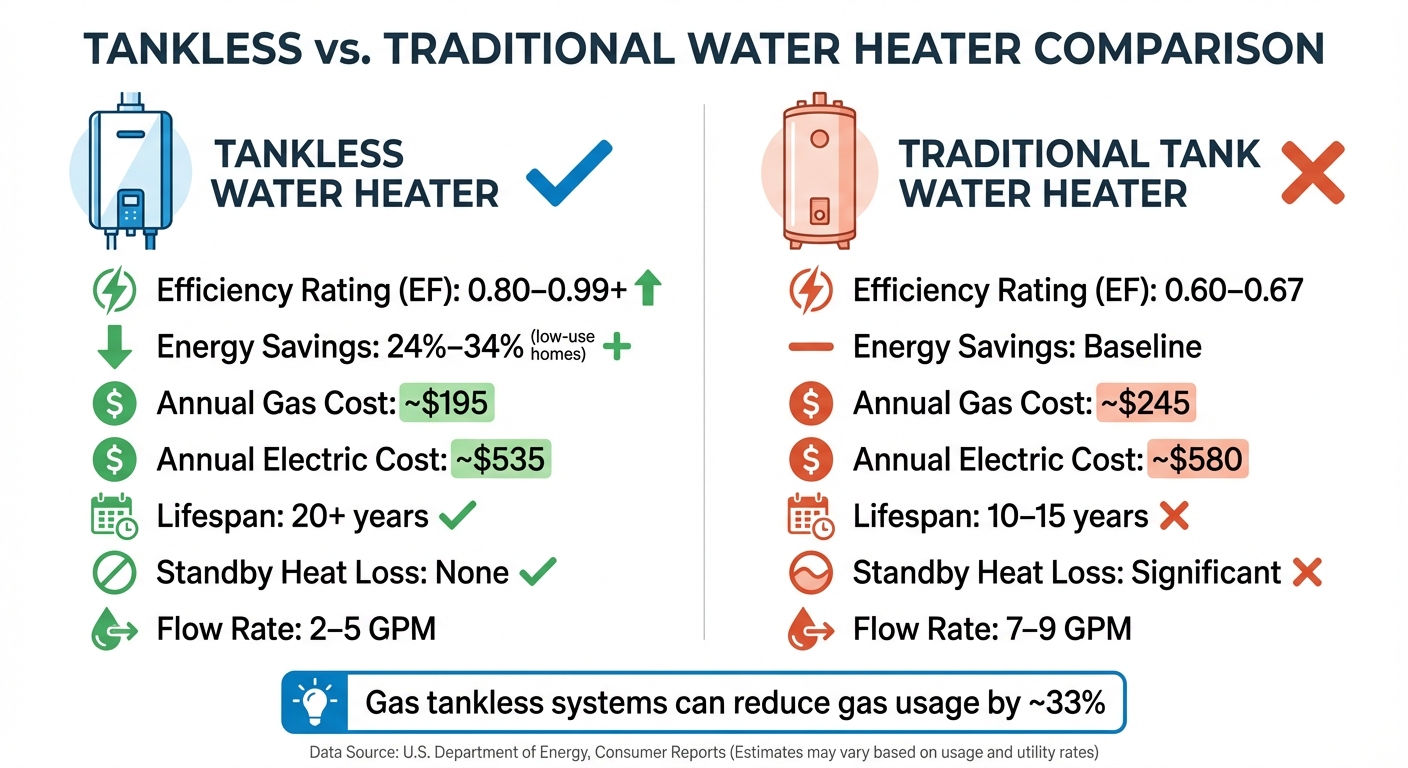
Tankless vs Traditional Water Heater Efficiency and Cost Comparison
Continuing from the earlier discussion on energy efficiency, let’s dive into the differences between tankless and traditional water heaters. The main distinction lies in how they operate: tankless water heaters heat water only when needed, while traditional systems keep a reservoir of water heated continuously, leading to standby heat loss.
The efficiency gap between the two is noteworthy. Gas-powered tankless systems typically achieve an Energy Factor (EF) of 0.80–0.82, whereas traditional gas water heaters average around 0.60. Electric tankless models are even more efficient, often exceeding 98%, compared to 80%–85% for traditional electric units. Depending on household water usage, tankless systems can improve efficiency by 24%–34% in homes with lower water demands and 8%–14% in higher-use households. These figures highlight the potential for energy savings and set the stage for a closer examination of their performance, costs, and longevity.
Tankless water heaters also stand out for their durability and lower operating costs. With a lifespan of over 20 years, they surpass the 10–15 years typical of traditional systems. Annual operating costs are another area where tankless units shine: gas models cost about $195 per year, and electric models average $535, compared to $245 and $580, respectively, for traditional systems. While the upfront cost of purchasing and installing a tankless system is higher, the long-term savings and durability help offset that initial expense.
"Tankless water heaters have a lot going for them. They’re also a great choice for homes with limited space, plus, you never run out of hot water, which is great for larger households." – Myles Robinson, Home Expert, UK Composite Doors
Efficiency and Cost Comparison Table
Here’s a quick side-by-side look at the key differences between tankless and traditional water heaters:
| Feature | Tankless Water Heater | Traditional Tank Water Heater |
|---|---|---|
| Efficiency Rating (EF) | 0.80–0.99+ | 0.60–0.67 |
| Energy Savings | 24%–34% (low-use homes) | Baseline |
| Annual Gas Cost | ~$195 | ~$245 |
| Annual Electric Cost | ~$535 | ~$580 |
| Lifespan | 20+ years | 10–15 years |
| Standby Heat Loss | None | Significant |
| Flow Rate | 2–5 GPM | 7–9 GPM |
Switching from a traditional gas storage tank to a gas tankless water heater can cut gas usage by roughly 33%. With their energy efficiency, extended lifespan, and ability to provide hot water on demand, tankless systems present a compelling option for those seeking a long-term solution.
Conclusion
Tankless water heaters are an energy-efficient way to heat water, eliminating standby energy loss by only heating water when needed. These systems can last over 20 years – almost twice as long as traditional tank water heaters. Plus, ENERGY STAR–certified gas models can save a family of four around $95 annually, adding up to approximately $1,800 over the unit’s lifetime.
But the benefits don’t stop at savings. Tankless water heaters deliver endless hot water, come in compact wall-mounted designs that free up floor space, and, when properly installed and maintained, operate at peak efficiency. Professional sizing ensures the unit can handle your household’s hot water needs, while annual maintenance – such as flushing the heat exchanger – keeps it running smoothly and extends its life. Expert installation is key to optimizing both performance and safety.
"Proper installation and maintenance of your demand water heater can optimize its energy efficiency." – U.S. Department of Energy
For professional tankless water heater installation in Miami, FL, reach out to Hernandez Plumbing at (tel:305-428-3782). Their licensed technicians handle everything from code compliance to safe venting and electrical setup. With 24/7 emergency services, upfront pricing, and a satisfaction guarantee, they’ve got you covered.
FAQs
How do tankless water heaters save energy and reduce costs compared to traditional models?
Tankless water heaters, often called on-demand water heaters, offer a smarter way to heat water by only activating when you need it. Unlike traditional models that continuously keep a full tank of water hot, these systems eliminate standby heat loss, cutting energy use by 24%–34%. For a family of four, this can mean saving about $95–$100 annually on utility bills, with potential lifetime savings reaching around $1,800.
While the initial cost of a tankless system is higher – averaging $4,400 compared to $1,600 for a standard tank heater – it’s worth noting their longer lifespan (20+ years versus 8–12 years for tank models) and reduced operating costs. Over time, these benefits often make tankless systems a more cost-effective choice. However, proper installation is crucial to ensure optimal performance, including correct sizing and venting. For homeowners in Miami, Hernandez Plumbing provides professional installation services, ensuring your system operates efficiently and meets local regulations.
What should I do to maintain my tankless water heater and keep it energy-efficient?
Regular upkeep is essential for ensuring your tankless water heater runs smoothly and lasts as long as possible. Here’s how you can stay on top of maintenance:
- Flush the system periodically: About every 6–12 months, flush the heat exchanger with a descaling solution to clear out mineral buildup. This helps maintain efficiency and prevents blockages.
- Clean the filters: Take time to clean the water inlet and air intake filters. Removing dust and debris ensures your system isn’t working harder than it needs to.
- Inspect for issues: Check water lines and vent pipes for any signs of leaks, corrosion, or loose fittings. Addressing these problems quickly can save you from bigger headaches down the line.
- Get a professional checkup yearly: Hire a licensed plumber to perform a detailed inspection. They’ll verify proper venting and fine-tune the system to keep it running at its best.
By keeping up with these tasks, you’ll enjoy a water heater that’s efficient, reliable, and easy on your energy bills. If you’re in Miami, Hernandez Plumbing offers expert maintenance services to help you maximize your system’s performance.
Can a tankless water heater provide hot water to multiple fixtures at the same time?
Yes, a tankless water heater can supply hot water to multiple fixtures at the same time, but it all comes down to its flow rate. The flow rate, measured in gallons per minute (GPM), determines how much hot water the unit can provide at once. For instance, if your shower uses 1.5 GPM and a sink faucet requires 1 GPM, the tankless water heater needs a flow rate of at least 2.5 GPM to handle both simultaneously without running out of hot water.
To get the best performance, it’s important to select a tankless water heater with a capacity that matches your household’s hot water demands. If you’re not sure what size is right, consulting a professional plumber can help you make the right choice.
Need Professional Help?
Our licensed plumbers are ready to help with your water heater services needs.