Tankless vs Traditional Water Heaters: A Cost Comparison
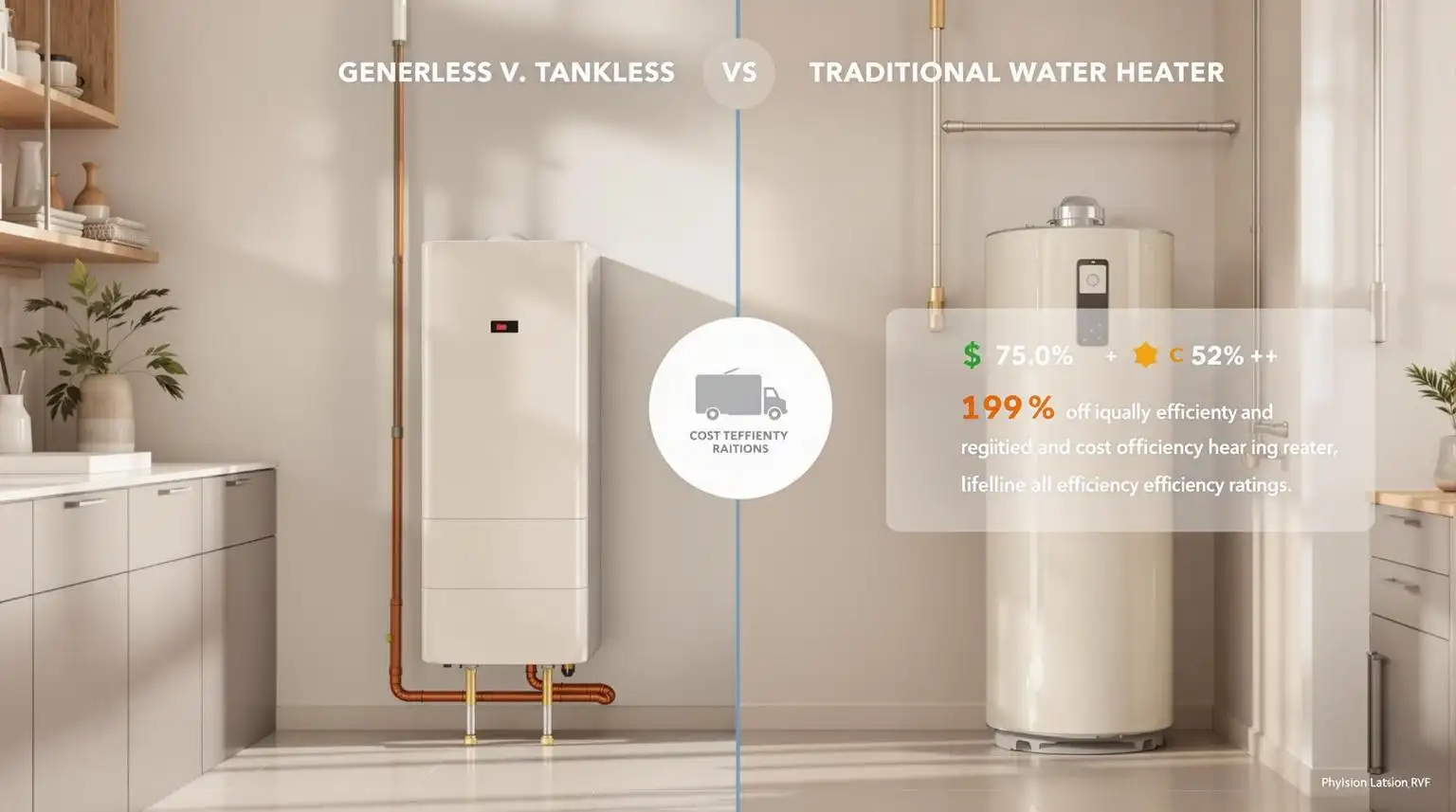
Looking for the right water heater? Here's what you need to know upfront:
- Tankless water heaters cost more initially ($1,000–$3,000 for the unit and up to $6,000 for installation) but are more energy-efficient (8%–34% improvement) and have a longer lifespan (20+ years). They also reduce annual operating costs to under $100. Our Miami plumber team specializes in tankless water heater installation.
- Traditional tank water heaters are cheaper upfront ($300–$2,000 for the unit and $400–$1,000 for installation) but have higher energy use (18% of household energy) and shorter lifespans (10–15 years). Annual operating costs range from $200–$800.
Quick Comparison:
| Feature | Traditional Tank | Tankless |
|---|---|---|
| Purchase Price | $300–$2,000 | $1,000–$3,000 |
| Installation Cost | $400–$1,000 | $1,000–$6,000 |
| Annual Operation | $200–$800 | Under $100 |
| Lifespan | 10–15 years | 20+ years |
| Efficiency | Lower (continuous heating) | Higher (on-demand heating) |
Bottom line: Tankless water heaters are ideal if you prioritize long-term savings and energy efficiency. Traditional tanks are better for lower upfront costs. Read on for details on costs, energy use, and durability.
Tank VS Tankless – 5000 Units Installed
Purchase and Installation Costs
Here's a breakdown of what you can expect to pay for equipment and installation of both traditional and tankless water heating systems.
Equipment Costs
For tankless water heaters, the unit alone typically costs between $1,000 and $3,000. On the other hand, traditional tank water heaters are priced between $300 and $2,000 for the tank itself.
Setup and Labor Fees
Installing a traditional tank system generally costs $400 to $1,000, while tankless systems come with a higher installation range of $1,000 to $6,000. This difference is largely due to labor costs, which are approximately $200 to $1,100 for traditional systems and $300 to $2,500 for tankless systems.
Cost Comparison Table
| Cost Component | Traditional Tank | Tankless |
|---|---|---|
| Equipment | $300–$2,000 | $1,000–$3,000 |
| Installation | $400–$1,000 | $1,000–$6,000 |
Tankless water heaters might have a steeper upfront cost, but they often last 20+ years, compared to the 10–15 years typical for traditional tanks. Use our water heater size calculator to determine the right capacity for your household. If you're considering an electric water heater, be sure to review the electric water heater codes by state for installation requirements in Florida. Our water heater services include expert installation and maintenance for both tank and tankless systems.
Which Is Cheaper: Tank or Tankless Water Heater?
Short answer: Traditional tank water heaters are cheaper upfront, but tankless water heaters are cheaper to operate over time.
When comparing total costs, you need to look at both the initial investment and long-term expenses:
- Upfront costs: A traditional tank water heater costs $700–$3,000 fully installed, while a tankless system runs $2,000–$9,000 installed.
- Operating costs: Tank heaters cost $200–$800 per year to run, while tankless units cost under $100 per year.
- Replacement frequency: You'll replace a tank heater every 10–15 years, but a tankless unit lasts 20–30 years.
20-Year Cost Comparison:
| Cost Type | Traditional Tank | Tankless |
|---|---|---|
| Initial Purchase + Install | $1,500 | $4,000 |
| Second Unit (replacement) | $1,500 | $0 |
| Operating Costs (20 years) | $8,000 | $2,000 |
| Total 20-Year Cost | $11,000 | $6,000 |
For most Miami homeowners, tankless water heaters save $3,000–$5,000 over 20 years despite the higher upfront cost. However, if you plan to move within 5–7 years, a traditional tank may be the more economical choice since you won't recoup the tankless investment.
Energy Use and Monthly Costs
Now that we've looked at upfront costs, let's dive into how operating costs can lead to long-term savings.
Efficiency Measurements
Tankless water heaters are up to 34% more efficient than traditional storage tanks because they heat water only when needed.
Monthly Bill Impact
Switching to a tankless system can lower your annual bills. Here's how the savings stack up:
| Heater Type | Annual Bill Savings |
|---|---|
| Electric Tankless | $40 |
| Gas/Propane Tankless | $100 |
Over time, these savings help offset the higher initial cost of tankless models.
Heat Loss Comparison
Traditional storage tanks lose energy year-round due to standby heat loss. Tankless systems, on the other hand, only heat water when it's flowing, resulting in those 8–34% efficiency improvements without needing extra features or adjustments.
sbb-itb-d8d3ac2
Durability and Ongoing Expenses
The lifespan and maintenance needs of a water heater play a big role in its overall cost of ownership.
Maintenance Needs
Storage tanks need regular flushing and inspections to prevent sediment buildup and corrosion. On average, basic annual maintenance costs range between $200 and $400. Tankless systems, on the other hand, require professional descaling every 1–2 years to keep the heat exchanger in good condition.
Long-Term Costs
| Cost Factor | Storage Tank | Tankless |
|---|---|---|
| Initial Cost | Lower | Higher |
| Service Life | 10–15 years | 20–30 years |
| Replacement Frequency | Every 10–15 years | Every 20–30 years |
| Repair Complexity | Simpler, lower cost | More complex, higher cost |
Over a 20-year period, the extended lifespan and reduced maintenance of tankless water heaters often make them more economical in the long run.
Is It Worth Replacing a Tank Water Heater with a Tankless?
Yes, in most cases — especially if your current tank water heater is more than 8–10 years old or showing signs of failure.
Here's when replacing makes the most sense:
- Your tank is aging: If your current water heater is over 10 years old, you're likely facing a replacement soon anyway. Upgrading to tankless now avoids emergency replacement costs and lets you start saving on energy bills immediately.
- You plan to stay in your home: The payback period for a tankless water heater is typically 6–12 years. If you'll be in your home long enough, you'll see significant savings.
- You want lower utility bills: Miami's warm incoming water temperature (around 75°F) means tankless units work efficiently here, requiring less energy to heat water to the desired temperature.
- You need more space: Tankless units mount on the wall and free up valuable floor space — a big advantage in Miami condos and smaller homes.
When it may NOT be worth it:
- You plan to sell within 5 years
- Your current water heater is less than 5 years old and working well
- Budget constraints make the upfront cost prohibitive
For a personalized assessment, contact Hernandez Plumbing for a free estimate on your tankless conversion.
What Are the Downsides of a Tankless Water Heater?
While tankless water heaters offer many benefits, they're not perfect for every situation. Here are the main disadvantages to consider:
1. Higher Upfront Cost Tankless units cost 2–3 times more than traditional tanks when you factor in equipment and installation. Budget $2,000–$9,000 for a complete tankless installation versus $700–$3,000 for a tank system.
2. Installation Complexity Switching from tank to tankless often requires:
- Upgrading gas lines (for gas models)
- Adding new venting
- Electrical upgrades (for electric models)
- Permits and inspections
3. Limited Flow Rate If multiple hot water fixtures run simultaneously (e.g., two showers plus a dishwasher), a single tankless unit may struggle to keep up. Large households may need multiple units or a high-capacity model.
4. "Cold Water Sandwich" Effect When hot water is used intermittently, you may experience brief bursts of cold water between uses. This happens because water sitting in the pipes cools between heating cycles.
5. More Complex Repairs When tankless units need repair, the parts and labor are typically more expensive than traditional tank repairs. However, this is offset by the tankless unit's longer lifespan.
6. Annual Maintenance Required Tankless water heaters need annual descaling to remove mineral buildup, especially in areas with hard water. Neglecting this maintenance can void the warranty and reduce efficiency.
Despite these drawbacks, most Miami homeowners find that the long-term savings and benefits outweigh the disadvantages. The key is choosing the right unit size and having it professionally installed.
Making Your Selection
Picking between a tankless and traditional water heater depends on your household's needs and the specifics of your location.
Sizing Your System
To find the right size, calculate your home's peak hot water demand. For example, two showers (20 gallons) and a dishwasher (6 gallons) would need a unit with a First Hour Rating of at least 26 gallons.
| Household Size | Recommended Tank Capacity (gal) |
|---|---|
| 1–2 people | 30–40 |
| 2–3 people | 40–50 |
| 3–4 people | 50–60 |
| 5+ people | 60–80 |
Consider the physical space and any specific requirements for your area, especially if you're in Miami.
Miami Space Considerations
In Miami, where utility spaces can be tight, tankless units are a popular choice due to their compact size. However, installing them may require:
- Ventilation upgrades
- Gas-line modifications
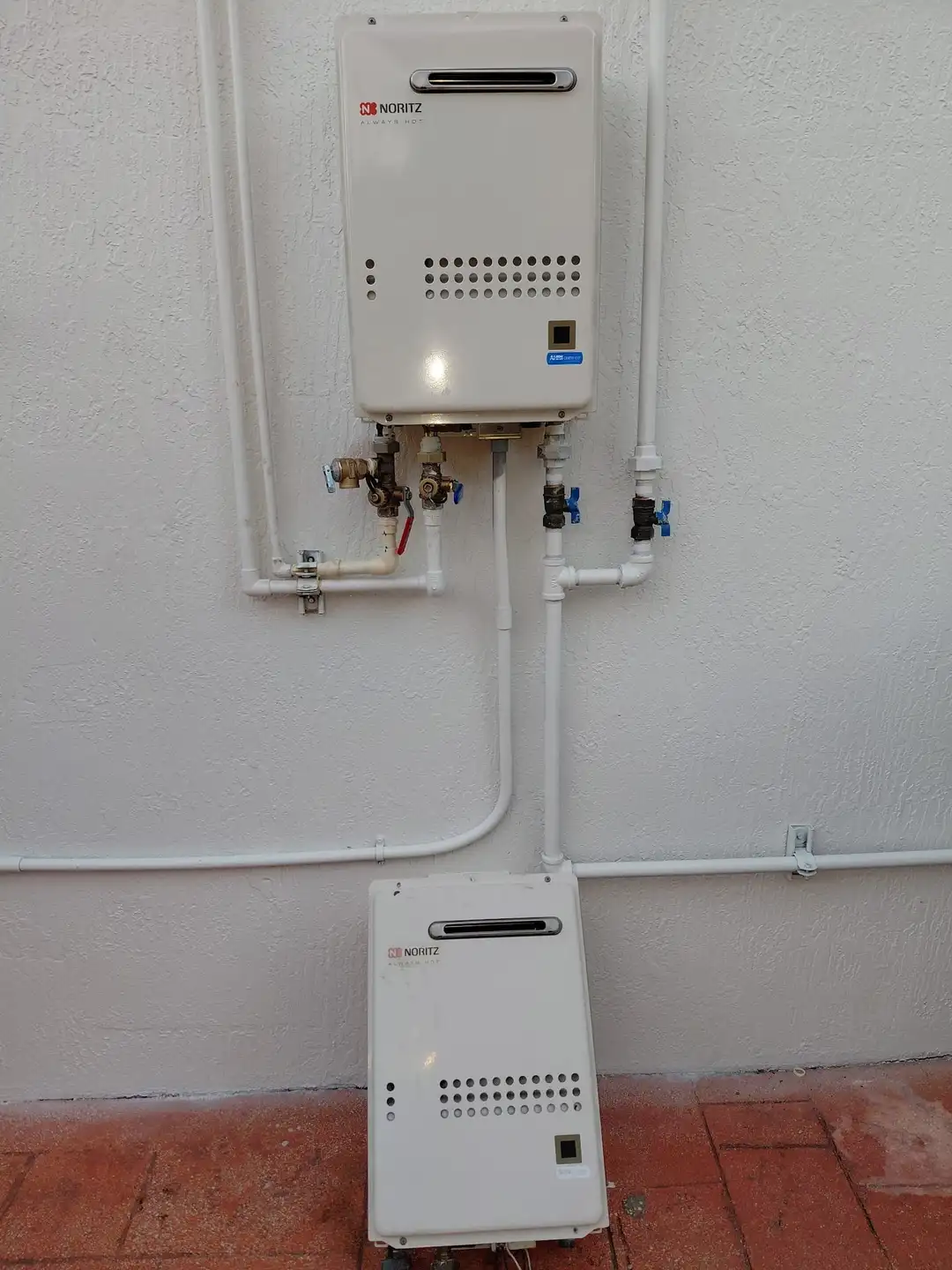 Professional outdoor installation of dual Noritz gas tankless water heaters – a space-saving solution ideal for Miami homes.
Consulting an expert is key to ensuring everything is installed correctly.
Hernandez Plumbing Services
Hernandez Plumbing provides:
- Help with selecting the right system size
- Full installation, including necessary ventilation and gas-line adjustments
- Repairs and replacements
- 24/7 emergency support
- Clear, upfront pricing
Their expertise ensures a hassle-free experience from start to finish.
Conclusion
When deciding between traditional and tankless water heaters, the choice often comes down to balancing upfront costs with long-term savings. Traditional water heaters are easier on the wallet initially, while tankless systems offer better savings over time. Traditional tanks account for up to 18% of a home's energy use, whereas tankless systems are far more efficient.
Tankless water heaters can reduce energy consumption by as much as 34%, leading to annual savings of $45–$110, depending on the model and fuel type. They also last over 20 years – about 10 years longer than traditional tanks. With their longer lifespan, lower maintenance requirements, and energy savings, tankless systems are an excellent option for those focused on long-term value.
For Miami residents, where space is often limited and water usage is high, tankless units frequently provide the best return on investment over two decades or more. Hernandez Plumbing's certified technicians ensure proper installation, offer transparent pricing, and provide maintenance services to keep your system running efficiently for years to come.
FAQs
What should I consider when choosing between a tankless and a traditional water heater for my home?
When deciding between a tankless and a traditional water heater, key factors to consider include cost, energy efficiency, and household needs. Tankless water heaters typically have a higher upfront cost, ranging from $3,000 to $4,500, while traditional models cost between $500 and $1,500. However, tankless systems are more energy-efficient, as they heat water on demand, potentially leading to long-term savings on utility bills.
You'll also want to think about your household's hot water usage, the unit's lifespan, and maintenance needs. Tankless water heaters generally last longer – up to 20 years or more – and require less maintenance compared to traditional models, which usually last around 10–15 years. Ultimately, the best choice depends on your budget, usage habits, and whether you prioritize upfront affordability or long-term efficiency.
What are the maintenance differences between tankless and traditional water heaters?
Tankless water heaters generally require more frequent maintenance compared to traditional models. For optimal performance, they need an annual cleaning of the heat exchanger, filter replacements every six months, and periodic flushing to remove sediment and mineral buildup. This helps prevent scaling and ensures efficient operation.
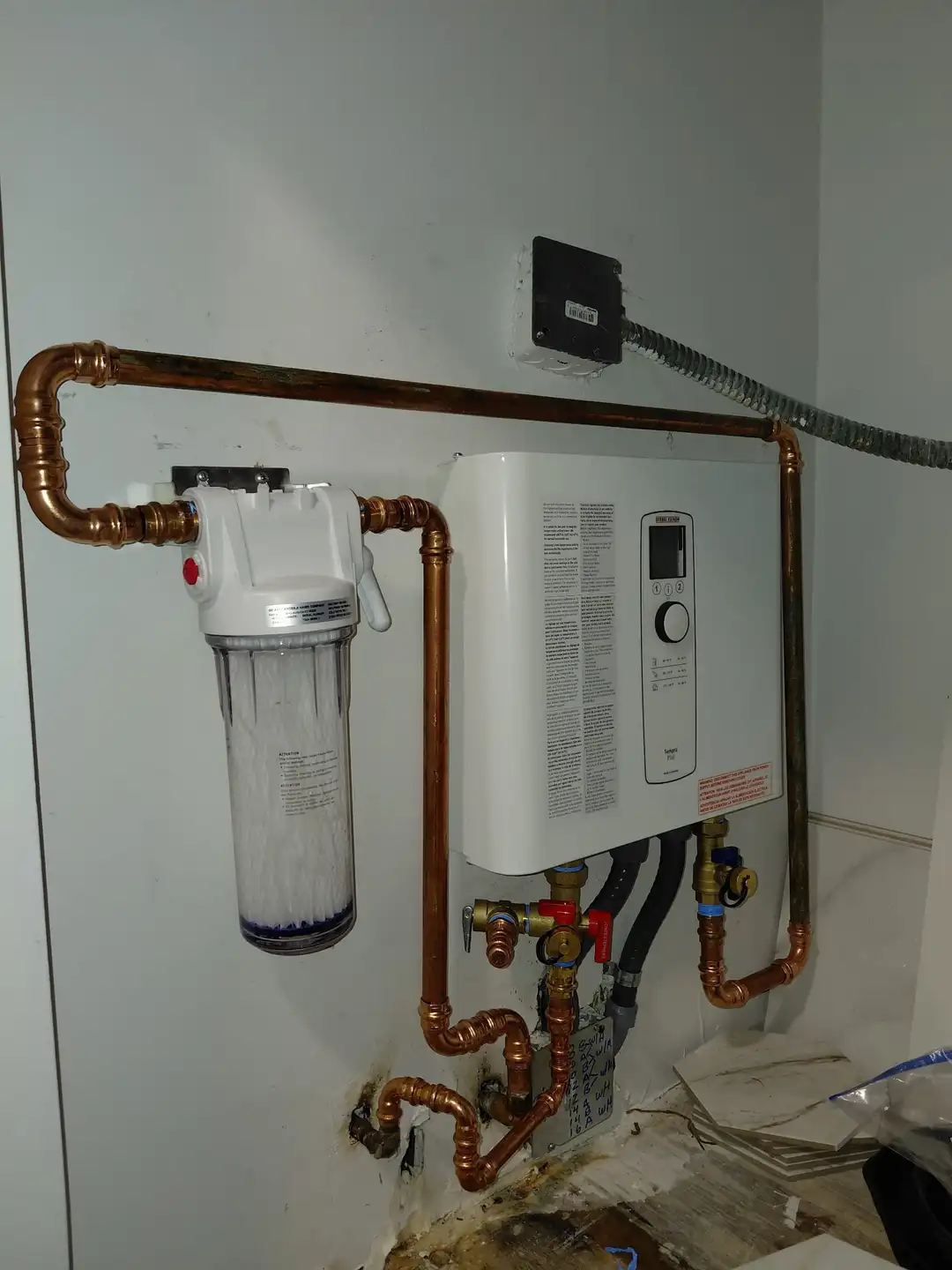 A tankless water heater with a pre-filter system installed – essential for protecting the unit from Miami's hard water and mineral buildup.
In contrast, traditional water heaters typically require less frequent upkeep. Maintenance tasks include an annual inspection and a tank flush to clear out sediment. While both systems benefit from regular care, the higher maintenance needs of tankless water heaters are often offset by their energy efficiency and longer lifespan.
Can a tankless water heater provide enough hot water for a large household, and how do I choose the right size?
Yes, a tankless water heater can supply enough hot water for a large household, but selecting the right size is essential to ensure it meets your needs efficiently. The key factors to consider are flow rate and temperature rise.
Start by calculating the total flow rate of all hot water fixtures you might use at the same time, measured in gallons per minute (GPM). For example, a shower typically uses about 2.5 GPM, while a kitchen faucet uses around 1.5 GPM. If you plan to use both simultaneously, your water heater should handle at least 4 GPM.
Next, consider the temperature rise – this is the difference between the incoming cold water temperature and your desired hot water temperature. For colder climates, where incoming water is cooler, you may need a more powerful unit. Choosing the correct size ensures consistent hot water without overloading the system, saving energy and avoiding interruptions.
How much does a tankless water heater cost for a 2,000 square foot house?
For a typical 2,000 square foot home in Miami (usually 3–4 bedrooms, 2–3 bathrooms), expect to pay $3,000–$6,000 for a tankless water heater fully installed.
Here's the breakdown:
- Unit cost: $1,000–$2,500 for a whole-house tankless unit with 8–10 GPM flow rate
- Installation: $1,500–$3,500 depending on whether gas line or electrical upgrades are needed
- Permits: $100–$300 in most Miami-Dade municipalities
A home this size typically needs a tankless unit rated for 8–10 GPM to handle two showers running simultaneously plus a dishwasher or washing machine. Contact us for a specific quote based on your home's configuration.
How long does a tankless water heater last compared to a traditional tank?
Tankless water heaters last 20–30 years with proper maintenance, while traditional tank water heaters last 10–15 years.
This significant lifespan difference is one of the main reasons tankless units are more cost-effective over time. A traditional tank experiences constant thermal stress from maintaining hot water 24/7, leading to faster corrosion and wear. Tankless units only heat water on demand, reducing wear on components.
To maximize your tankless water heater's lifespan:
- Schedule annual descaling service
- Replace inlet filters as recommended
- Ensure proper venting (for gas models)
Do tankless water heaters work well in Miami's warm climate?
Yes — Miami's climate is actually ideal for tankless water heaters. Here's why:
- Warmer incoming water: Miami's groundwater temperature averages 75°F, compared to 50°F in northern states. This means tankless units need to work less hard to heat water, improving efficiency and flow rates.
- Higher effective GPM: A tankless unit rated for 8 GPM in cold climates can deliver 10+ GPM in Miami because of the reduced temperature rise needed.
- Lower energy costs: Less energy is required to reach your desired water temperature, amplifying the energy savings compared to tank heaters.
Miami's year-round warm climate makes tankless water heaters even more efficient than manufacturer ratings suggest.
Can I install a tankless water heater myself, or do I need a professional?
Professional installation is strongly recommended for tankless water heaters. Here's why:
- Permits required: Miami-Dade and Broward counties require permits for water heater installation. Unpermitted work can cause issues when selling your home.
- Gas line modifications: Gas tankless units often need larger gas lines to meet BTU requirements. This work must be done by a licensed plumber.
- Electrical requirements: Electric tankless units require dedicated circuits (often 150–200 amps), which need a licensed electrician.
- Warranty protection: Most manufacturers require professional installation to honor the warranty.
DIY installation can void your warranty, create safety hazards, and violate local building codes. Schedule a professional installation to ensure your system is safe and code-compliant.
Which is better for Miami homes: electric or gas tankless water heater?
Both work well in Miami, but the best choice depends on your home's infrastructure and hot water needs:
Gas Tankless Water Heaters:
- Pros: Higher flow rates (8–11 GPM), lower operating costs, work during power outages
- Cons: Require venting, need adequate gas line capacity, higher installation cost
- Best for: Larger homes, families with high hot water demand
Electric Tankless Water Heaters:
- Pros: No venting needed, easier installation, compact size, lower upfront cost
- Cons: Lower flow rates (3–8 GPM), require significant electrical capacity, don't work during outages
- Best for: Condos, smaller homes, point-of-use applications
Most Miami single-family homes benefit from gas tankless units due to higher flow rates. Condos often use electric tankless because gas lines may not be available. Contact us for a recommendation based on your specific situation.
Are tankless water heaters worth it for a family of 4?
Yes, tankless water heaters are typically worth it for a family of 4, especially in Miami. Here's the math:
- Energy savings: $100–$150 per year compared to a tank heater
- Lifespan advantage: 20+ years vs. 10–15 years (avoiding one replacement cycle)
- Space savings: Frees up 10–16 square feet of floor space
Break-even timeline: Most families recoup the extra upfront cost within 8–12 years through energy savings alone. When you factor in avoiding a second tank replacement, tankless becomes the clear winner for long-term ownership.
For a family of 4, we recommend a tankless unit with at least 7–9 GPM flow rate to comfortably handle morning routines with multiple showers and appliances running.
Need Professional Help?
Our licensed plumbers are ready to help with your water heater services needs.